
Engineering· · 5 min read
From pilot to rollout: a realistic IoT timeline
How long does an IoT pilot take? A week-by-week timeline from kick-off to full rollout in four months, what usually slips, and how to de-risk it.
By Alessio Grespi, Founder & CEO
Most buyers assume a sensor project means a year of meetings before anything useful appears. It doesn't have to. When the hardware and cloud already exist, an IoT pilot can be live inside two months and a full rollout finished inside four.
This post sets out what happens week by week, where the time usually goes missing, and what to agree before you start.
Why IoT pilots drag
Pilots rarely fail on technology. They stall for four ordinary reasons.
- Nobody agreed what success looks like. Without a measure written down, the pilot never ends. It just gets extended.
- The hardware is being invented during the pilot. A custom board, enclosure and firmware built from scratch adds months before a single reading arrives.
- Procurement starts after the pilot. If pricing and contract terms are only discussed once the pilot works, the rollout waits on a second sales cycle.
- The pilot is free. A pilot nobody pays for has no owner on the buyer's side, and it drops down everyone's list.
Weeks 1 to 8: the pilot
A pilot should answer one question on a small number of sites. Eight weeks is enough when the sensor is built from proven design blocks and the platform already exists.
| Week | What happens | Who is needed |
|---|---|---|
| 1 | Kick-off. Agree the question, the success measure, the sites and the rollout price. | Buyer sponsor and supplier |
| 1 to 3 | Design. The sensor is assembled from proven design blocks, starting on day 1 with the parts unlikely to change. | Supplier |
| 2 | Site survey. Fix sensor positions, check connectivity and arrange access. | Site or facilities contact |
| 4 to 5 | Manufacture and bench-test. Pilot units built, tested and configured. Dashboard and alerts set up. | Supplier and manufacturer |
| 6 to 7 | Installation on site. | Supplier and site contact |
| 7 to 8 | Live data. Starts as the first units go in and carries on three weeks into rollout. Alert thresholds tuned and false alarms removed. | Supplier, with the people who will use the data |
| 8 | Review against the success measure. Go or no-go on rollout. | Buyer sponsor and supplier |
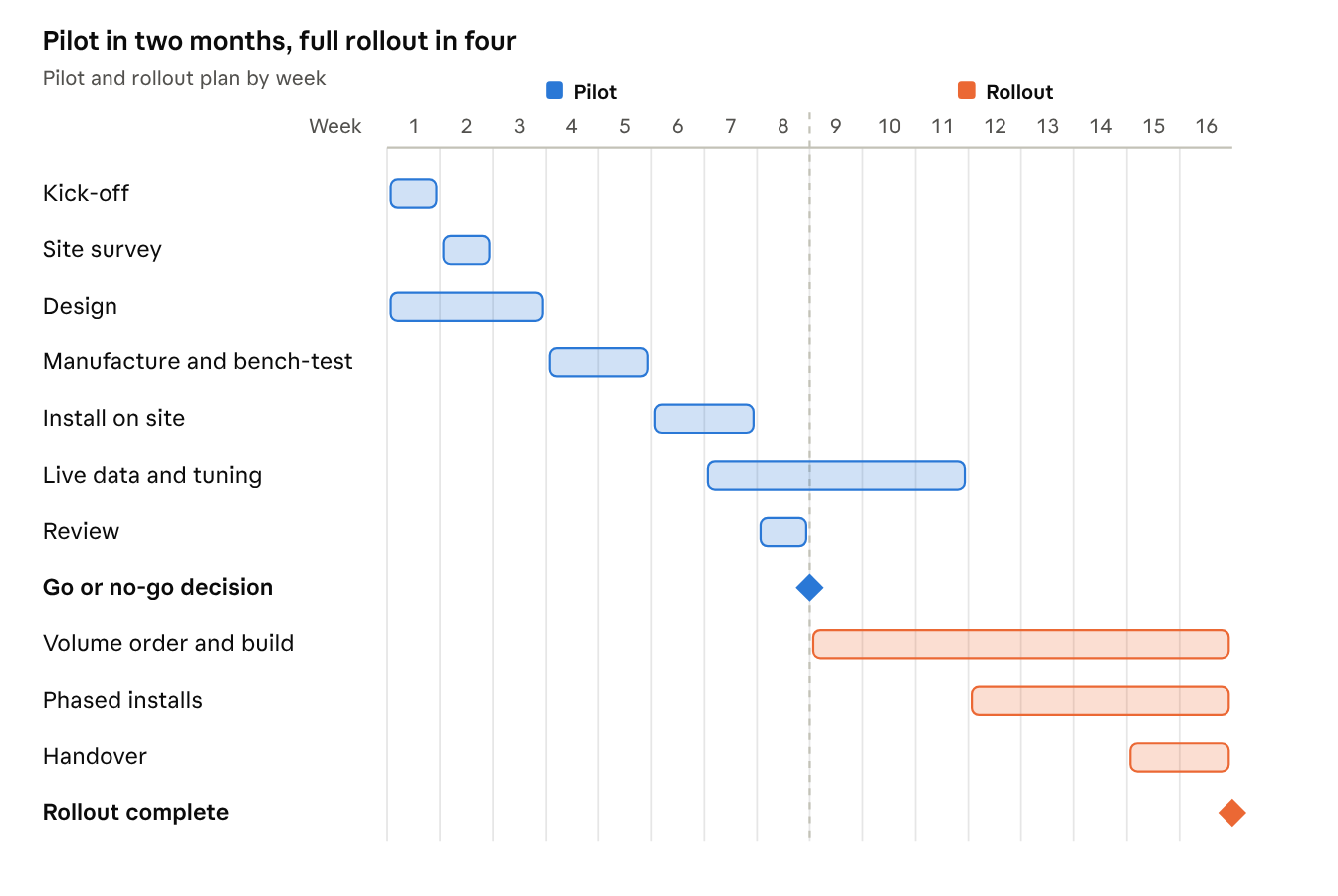
Each bar is one stage. The pilot closes with a go or no-go decision at the end of week 8, and rollout runs from week 9 to week 16. The volume order runs the length of the rollout, installs begin three weeks in, and handover overlaps the last installs.
Pick sites that include your hardest case: the basement plant room, the remote building, the one with no Wi-Fi. A pilot that only proves the easy site tells you little about rollout.
Months 3 to 4: the rollout
Rollout is a logistics job, not an engineering one. Its speed is set by hardware stock and by how many sites can be installed each week.
- Order hardware at sign-off. Place the volume order the day the pilot is approved, or earlier if you are confident.
- Install in phases. Group sites by geography and work through them in batches.
- Go live site by site. Each site starts reporting as soon as it is installed. There is no big switch-on day.
- Hand over. Train the people who will use the data, set up reports and agree who to call when something looks wrong.
What slips
- Manufacturer stock. Radio modules and components can move from in stock to a lead time of several weeks without warning. This is the one delay a supplier cannot fully control.
- Manufacturer build times. Assembly houses work to their own production queue. Paying for an expedited slot shortens the wait, but boards still have to be built, tested and shipped, so allow weeks rather than days.
- Site access. Permits, inductions, tenants and out-of-hours rules slow installs more than any technical issue.
- Connectivity surprises. Plant rooms and basements are hard places for radio. A proper survey in week 2 finds this before install day.
- Scope creep. "While you're there, can it also measure..." is how an eight-week pilot becomes a six-month one. Park new ideas for a second phase.
- Internal sign-off. IT security and data protection reviews take time. Start them in week 1, not week 8.
How to de-risk it before you start
- Write the success measure in one sentence. For example: "Readings from every monitored point arrive at least hourly for two weeks, and alerts reach the right person."
- Agree the rollout price and terms before the pilot. If the pilot passes, rollout should need a signature, not a negotiation.
- Use proven design blocks. A custom sensor assembled from tested radio, power and sensing blocks reaches site far sooner than one drawn from a blank page. Start the fundamentals that are unlikely to change, such as the radio, microcontroller and power design, on day 1.
- Pay for the pilot. Even a modest fee gives it an owner and a deadline.
- Name one owner on each side. One person who can make decisions and get site access sorted.
- Send the security questionnaire in week 1.
Frequently asked questions
How long does an IoT pilot take? About eight weeks when the sensor is built from proven design blocks: five weeks of design, survey and manufacture, then three of install, live data and review.
How many sites should a pilot cover? One to three. Enough to include your most difficult site, and few enough to install in a week.
How long should a pilot collect data? At least two weeks of live readings. Go longer if what you are measuring changes with the season or with building occupancy.
What decides how fast rollout goes? Hardware stock, site access and the number of installs per week. The software is rarely the constraint.
Planning a pilot?
Paqett designs, deploys and runs sensor networks, sold under your brand or built to your spec. We aim for a pilot within two months and full rollout within four, subject to manufacturer stock. Talk to us about what you need measured.